

Three Words for Healing: Only One Asks for Faith
Part 4 of 6 · When Healing Doesn’t Come

New to the series? Start with Part 1: When We Question If Faith Is Enough.
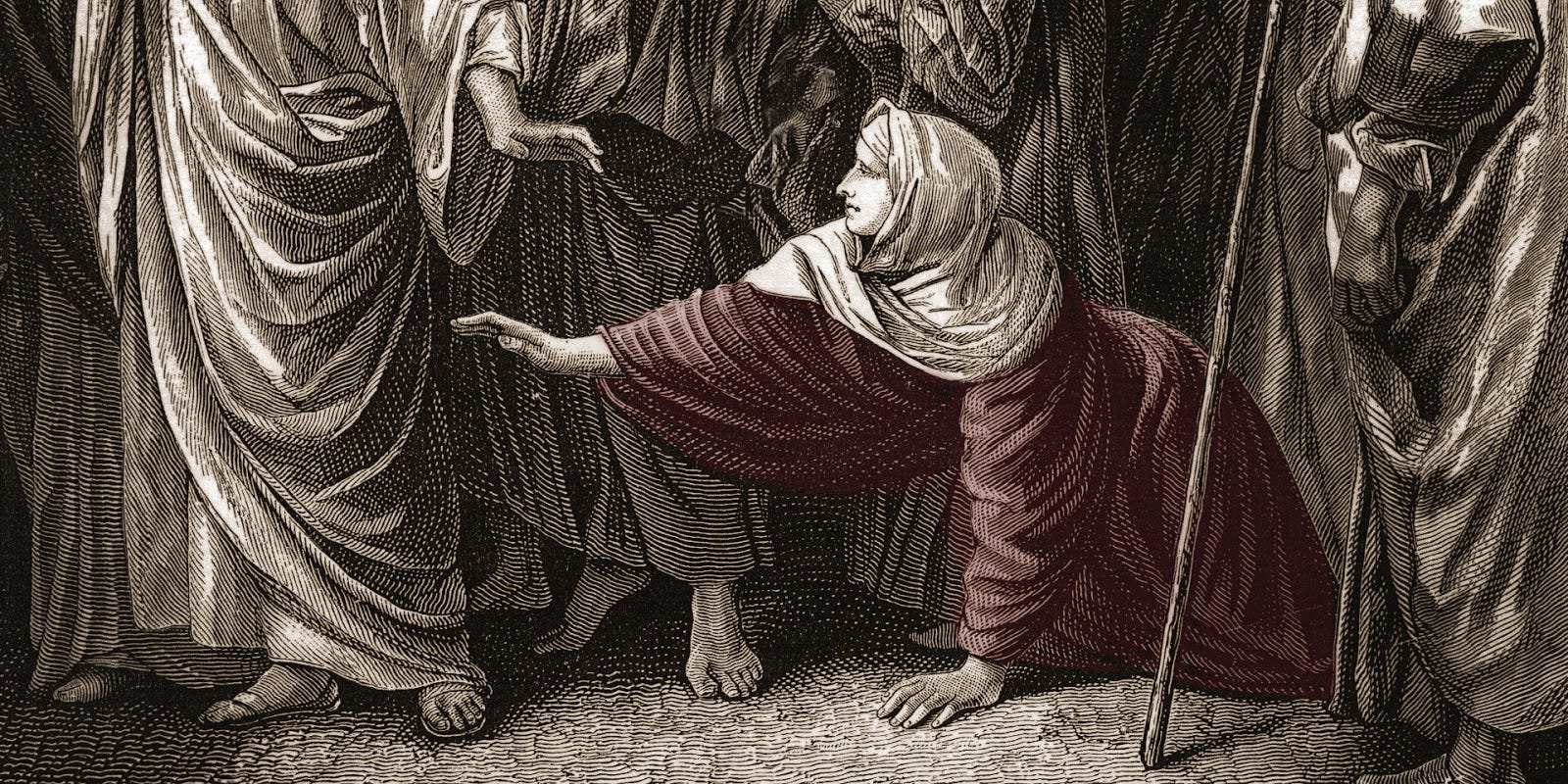
Until now, this series has primarily been in English. This week, we briefly step into the Greek, the original language of the New Testament.
In grad school, years after losing Josiah, I wrote a forty-five-page paper on faith as it relates to healing in the Gospels. That paper is the basis for this series. It wasn’t just an academic project. I wanted to know what the Scriptures actually say when held up against what we lived through. So, I went looking and tracked every passage one by one.
I promised back in Part 1 that this wouldn’t get too technical, and I’m keeping that promise. We’ll look at the three primary Greek verbs for healing and then visit one story in which all three appear. Everything in Scripture is there for our good. What the Greek vocabulary answers, and what it refuses to answer, lifts a weight you may have been carrying for a long time.
This post asks: Was the sick person’s faith the key factor in their healing?
The answer, as I read it, is no. Not once does Scripture place the decisive weight of healing on the faith of the one who is suffering. Not in Matthew. Not in Mark. Not in Luke. Not in John. Not even in the rest of the New Testament. The faith Jesus commends in the people he heals turns out to be different from what our church language often implies, and the words the Gospel writers use make the difference impossible to miss.
This post asks: Was the sick person’s faith the key factor in their healing?
The answer, as I read it, is no.
Three words, in plain English
The New Testament uses three primary verbs to describe healing. Each carries its own weight, and the writers don’t use them interchangeably.
The first is therapeuō. It’s the most common of the three, appearing more than forty times in the Gospels, and it’s the root of our English word therapy. It means to treat, to attend to, or to restore someone to health. It’s the word the writers most often reach for when summarizing what Jesus did in the crowds. He healed many who were sick (Matt 8:16). Big scenes. Bodies tended. Symptoms addressed.
The second is iaomai. It’s a more clinical, more decisive word. While therapeuō can carry a sense of ongoing care, iaomai tends to mean a complete, often instantaneous restoration. Luke, the physician among the Gospel writers, prefers this word, using it more than twice as often as the others combined.1 When the centurion says, “Just say the word, and my servant will be healed,” the verb he uses is iaomai (Matt 8:8; Lk 7:7).2
The third is sōzō. This one is so different from the other two that it’s easy to miss in English. Our translators have to make choices that the Greek refuses to make. Sōzō is most often translated as “to save.” The soldiers at the cross use this to mock Jesus, “let him save himself” (Matt 27:42). It’s the word Paul reaches for when he writes that “by grace you have been saved through faith” (Eph 2:8). It’s a word for rescue, for deliverance, for being pulled out of harm and into safety.
This is what I want you to hold close: sōzō is the one Jesus uses again and again when he says to the people he’s just healed, “your faith has made you well.”
Hold that. We’ll come back to it.
What the words tell us
Here’s the part that surprised me, and that I now want to walk with you slowly by stating it three times in three different ways.
In the Gospels, when Jesus performs a physical healing, the verbs therapeuō and iaomai do most of the work. And in every instance where those are used, the faith of the person being healed is never named as a prerequisite.
Let me say it again. In every case where the words therapeuō and iaomai appear, the recipient’s faith is either not mentioned at all or, when faith is in view, belongs to someone other than the one being healed.
In other words, in not one passage does Jesus stop to evaluate whether the sick person believed enough before restoring their body.3
When the crowds press in at sundown in Capernaum and Jesus therapeuō-es them all (Matt 8:16), there’s no faith inventory. They get carried in. They get brought to him. They get healed.
When the disciples are sent out and given authority to therapeuō the sick (Lk 9:1-2), there’s no instruction to check the faith of those they encounter.
When a father brings his demon-tormented boy, and the disciples can’t drive the spirit out, Jesus rebukes the little faith of his disciples (Matt 17:20). Not the boy. Not the father. The disciples. As one New Testament scholar puts it, faith is the responsibility of those who minister.4
The pattern holds for iaomai too. When the centurion’s servant is iaomai-ed, the faith Jesus commends belongs to the centurion, not to the servant lying paralyzed at home. When the Canaanite woman’s daughter is iaomai-ed, the faith Jesus commends belongs to the mother, not to the daughter, who isn’t even in the conversation.
But I want to pause here because if we’re not careful, we’ll shift the burden one seat over.
Some of you reading this have prayed for a child, a parent, a friend, a spouse. You’ve stayed up at night carrying their suffering as if it were your own, and in some real way, it is. I want to be clear: the Gospel writers are not setting up the centurion and the Canaanite mother as exemplars of a faith-quota for caregivers. The narratives describe what happened in those particular moments. They don’t prescribe a formula that says if your child wasn’t healed, you must not have believed hard enough. That reading puts a weight on you that the text never asks of you.
Where the New Testament does speak about the faith of those ministering, it tends to point us to the elders of the church and to the gifts of the Spirit Jesus has given (James 5:14-15), not to the bedside of a desperate parent. We’ll come back to that pattern in Post 6.
So where, then, does the recipient’s faith show up? It only shows up in one place: the sōzō passages.
The word that holds salvation
So where, then, does the recipient’s faith show up? It only shows up in one place: the sōzō passages.
The Greek phrase Jesus repeats more than any other in this conversation is: hē pistis sou sesōken se.5 Word for word: your faith has saved you.
He says it to the woman with the issue of blood (Mk 5:34). He says it to blind Bartimaeus (Mk 10:52). He says it to the one Samaritan leper who turned back to thank him (Lk 17:19). He says it to the woman in Simon the Pharisee’s house who washes his feet with her tears (Lk 7:50), where no healing takes place at all.
Same word. Same construction. Same Jesus.
The word sōzō carries a lot, so every English translation has to make choices. Healed in one verse, saved in another, made well in a third. This isn’t a flaw. Faithful translators do their best with a word that holds more than a single English word can.
The Greek simply refuses to keep them apart. So when Jesus says hē pistis sou sesōken se, he uses the same word over a body just made whole as over a soul that has just been forgiven. For him, the body and the soul are not in separate categories.
When sōzō shows up in Jesus’s healings, it never names a specific body part. It always reaches for the whole person.6 Even when the scene is unmistakably about a body being made well, the larger sense of the word is never far away: restoration to fullness of life, for this life and the life to come.7
What the Gospel writers seem to signal by using this one verb across all these scenes is that what Jesus is doing in the body is not a different work from what he is doing in the soul. It’s the same work. It’s sōzō. It’s salvation. And whenever the recipient’s faith is named, it’s named in connection with this word and only this word.
So, when we ask what kind of faith Jesus actually commends, the Greek answer is not the kind of faith that produces a cure. It’s the kind of faith that recognizes who he is. Faith in the person. Faith for salvation. Faith that says Lord. Faith that says Son of David. Faith that falls at his feet. The expression your faith has sōzō-ed you in all these passages is not simply a statement about physical healing, but rather a statement about salvation, a salvation received because of faith in Jesus.8 That’s what the word sōzō is doing.
Now let’s look at a scene where all three healing words appear together, and the whole thing comes into focus.
So, when we ask what kind of faith Jesus actually commends, the Greek answer is not the kind of faith that produces a cure.
All three healing verbs in seven verses
Luke 8:42-48. The bleeding woman.
She has been hemorrhaging for twelve years. Mark adds that she’d spent everything she had on physicians and only gotten worse (Mk 5:26). The verb Luke uses for what the doctors had been failing at is therapeuō. They had been treating her, and it hadn’t worked (Lk 8:43).
Do the math for a moment. Twelve years of bleeding puts her at roughly twenty-four or twenty-five years old. Jewish women in the first century typically began menstruating between the ages of 12 and 14.9 Which means this woman has been ritually unclean since she was barely out of childhood. Unclean as a girl. Unclean through the years when most young women in her village were preparing for marriage. She could not be touched, could not worship at the temple, could not fulfill the wife-and-mother roles that defined a Jewish woman’s covenant life. A covenant life that went on around her, and she stood outside it.
She presses through the crowd and reaches for the edge of his cloak. And in that moment, before Jesus says a single word to her, the bleeding stops.
Describing the moment, Luke uses the verb iaomai (Lk 8:47). Instant. Complete. By his power. Not gradual. Not partial. Not negotiated. The twelve years are over.
Some scholars think she may have reached for the fringe of his garment with a particular Old Testament promise in mind. The prophet Malachi had written that “for you who fear my name, the Sun of Righteousness will rise with healing in his wings” (Mal 4:2). The Hebrew word for wings is kanaph. A word also used for the corner or fringe of a garment. So, when she sees this rabbi everyone is talking about, she sees a man whose cloak has corners her Bible calls wings. “What if it’s him? What if he’s the one? Maybe healing really is in his wings. Maybe all I have to do is reach.”10
If that’s what she’s doing, she isn’t reaching for magic. She’s reaching for the Messiah.
“What if it’s him? What if he’s the one? Maybe healing really is in his wings. Maybe all I have to do is reach.”
But here’s the part I want you to see. She’s already healed. The bleeding has stopped. The iaomai is done. When Jesus turns and asks who touched him, she comes forward, trembling, and falls at his feet. His response: Daughter, your faith has sōzō-ed you. Go in peace (Lk 8:48).
Sōzō. The salvation word. The third verb. It lands after the body is already made well, which means it can’t only be about the body.
Daughter. It’s the only time Jesus addresses someone like that. He doesn’t call her child. He doesn’t call her woman. He calls her Daughter. After twelve years of being cut off from covenant life, after years of being untouchable in the very community that should have been family, Jesus reaches across all of it and names her into the identity she has always held. She’s been a daughter the whole time. Now she’s hearing it spoken.
Then he says, “Go in peace.” The word for peace is eirēnē, the Greek term most often used by translators to render the Hebrew shalom. The wholeness, completeness, and fullness of life under God’s good order we discussed in Part 3.
So the woman who began the scene with a body the doctors could not therapeuō, that Jesus iaomai-ed in a moment of touch, walks out of the scene having received sōzō: salvation, restoration to covenant, a name spoken over her she was never allowed to wear, and the shalom that prophets had been proclaiming for centuries.
You can’t tell me she earned all that by generating an arbitrary size or quality of faith. She simply came to Jesus, recognized who he was, and trusted what she recognized. Her coming was the faith. He did the rest.
A word for the one in the middle of it
Some of you reading this have been told, gently or not so gently, that your healing is being held back by some lack of faith. I want to say, with as much weight as I know how, that the Gospels never put that on you. Not on the sick person. Not on the parent. Or the spouse. Or the friend at the bedside.
The faith the Gospels invite isn’t a force you muster or a feeling you manufacture. Faith is simply the courage to ask.11 To come to Jesus and lay your suffering before him. To say “Lord, help me.” To say, “I believe; help my unbelief” (Mk 9:24). To reach, even trembling, for the edge of his garment because you’ve come to recognize who he is. That’s the faith all the sōzō passages describe.
Faith is simply the courage to ask.
There are griefs we carry when therapeuō or iaomai doesn’t come. What I can tell you, years removed from the asking, is that the sōzō spoken over Josiah, and spoken over every family who has held similar loss, is not the smaller thing. It might, in the end, be the larger thing. We tend to read salvation as a consolation prize and the cure as the main event. The Gospels arrange those two the other way around.
Even still, faith is not a small thing. It’s everywhere in the Gospels, and Jesus is after it everywhere he goes. Next week, we’ll turn to faith itself, and I think what we find may surprise just as much as the word healing.
One last question, if you’ll humor me.
Which of the three words, therapeuō, iaomai, or sōzō, do you need most in your situation right now? You don’t have to explain. Even one word in the comments tells the next reader they’re not alone.
And if this piece lifted a weight, think of one person who’s been carrying the same, quietly wondering whether their faith was enough. This was written as much for them as for you. Send it their way. If the series has been worth your Tuesday mornings, forwarding it to someone is the kindest way to help it find the people who need it.
See you next week.
Luke uses iaomai more than the other three Gospel writers combined, a pattern most commentators read as reflecting his medical vocabulary. Louise Wells, in her study of healing language from Homer through the New Testament, distinguishes between therapeuō (which can imply ongoing treatment that may or may not succeed) and iaomai (which tends to imply complete and immediate restoration). The Gospel writers don’t draw a hard line between the two verbs, but the pattern Wells identifies is real. Louise Wells, The Greek Language of Healing from Homer to New Testament Times (De Gruyter, 1998).
Worth noting: the centurion himself reaches for the more decisive verb. He is not asking for treatment; he is asking for restoration by a word.
The pattern is sustained across all four Gospels, and it is striking enough to bear interpretive weight even if a borderline exception could be argued. The negative claim is not that faith never appears near a healing. It is that the faith of the suffering person is never named as the lever that produced the cure.
Øyvind Gaarder Andersen, on Matt 17:14-20, observes that the rebuke for little faith in this scene is directed at the disciples, not at the boy or the father. His broader claim, faith is the responsibility of those who minister, captures a pattern the Gospels return to repeatedly. The pattern doesn’t disappear in the early church. James 5:14-15 places the faith-responsibility for healing on the elders, not on the sick person calling for them.
The form that appears in the verse is sesōken, not sōzō. Sōzō is the dictionary form, the way you would find the verb listed in a lexicon. Sesōken is that same verb conjugated for this sentence, much as the English “save” becomes “has saved” once it takes a tense and a subject. Also, the tense here is the Greek perfect, which carries a completed action whose result still stands. Her faith saved her, and the saving holds. What a beautiful thought!
Werner Foerster’s observation that sōzō always concerns the whole person, never an isolated limb or organ, is the lexical foundation for reading the your faith has saved you passages as something more than reports of physical recovery. Foerster, Σῴζω, Σωτηρία, Σωτήρ, Σωτήριος, in Theological Dictionary of the New Testament, ed. Gerhard Kittel, Geoffrey W. Bromiley, and Gerhard Friedrich (Eerdmans, 1986).
M. Eugene Boring, Mark: A Commentary (Westminster John Knox, 2006). Boring writes that sōzō is a rich word, tied to ideas like have eternal life, enter the kingdom of God, and be saved. Even where it functions in a healing context, the eschatological connotation isn’t far away.
Jennifer Anne Cox, A Re-Examination of Faith and Healing in the Gospels: Toward a Pentecostal Theology of Healing and Disability, Cyberjournal for Pentecostal-Charismatic Research 24 (June 2017), http://www.pctii.org/cyberj/cyberj24/cox.html.
The estimate is conservative. Some scholars place the average age of menarche in first-century Palestinian Jewish girls slightly later, others slightly earlier. The point holds either way: a woman bleeding for twelve continuous years has been ritually unclean long enough to lose every social and religious anchor a young woman’s life would have been organized around.
The Malachi/kanaph reading is one well-supported way to make sense of why she reached for the fringe specifically. Fries, Rummage, and Gallaty put it strongly: “In doing so she was confessing that Jesus Christ was the sun of righteousness from Malachi 4. He was God Himself.” Micah Fries, Stephen Rummage, and Robby Gallaty, Exalting Jesus in Zephaniah, Haggai, Zechariah, and Malachi, ed. David Platt, Daniel L. Akin, and Tony Merida, Christ-Centered Exposition Commentary (Holman Reference, 2015), 273.
We’ll explore this in Part 6 but, James 5:14-16 places the responsibility for faith-filled prayer squarely on the elders, who are called on. The sick person’s role is to call for them, confess sin, and simply ask. “For the one receiving healing, faith is simply the courage to ask and the willingness to be honest about sin.” I borrowed that line from my own graduate work on this passage, and it is the line I invite you to take from this post.
Another excellent piece. This whole series hits home for me.
Really good my friend