



In August 1666, 360 years ago this month, a committee met in London to decide what to do about St. Paul’s.
The old cathedral was in rough shape. A thirty-three-year-old astronomy professor named Christopher Wren, not yet the world-renowned architect, came in with drawings: take the truncated central tower off and put a dome in its place. John Evelyn was in the room arguing the same side. After what Evelyn called much contest, the room assented, and Wren was sent off to price the work.1
Six days later a fire started in a bakery on Pudding Lane. By the fourth of September it had reached the cathedral, and the lead melted off the roof and ran down the streets. Old St. Paul’s was finished.2
Nobody ever brought in that estimate.
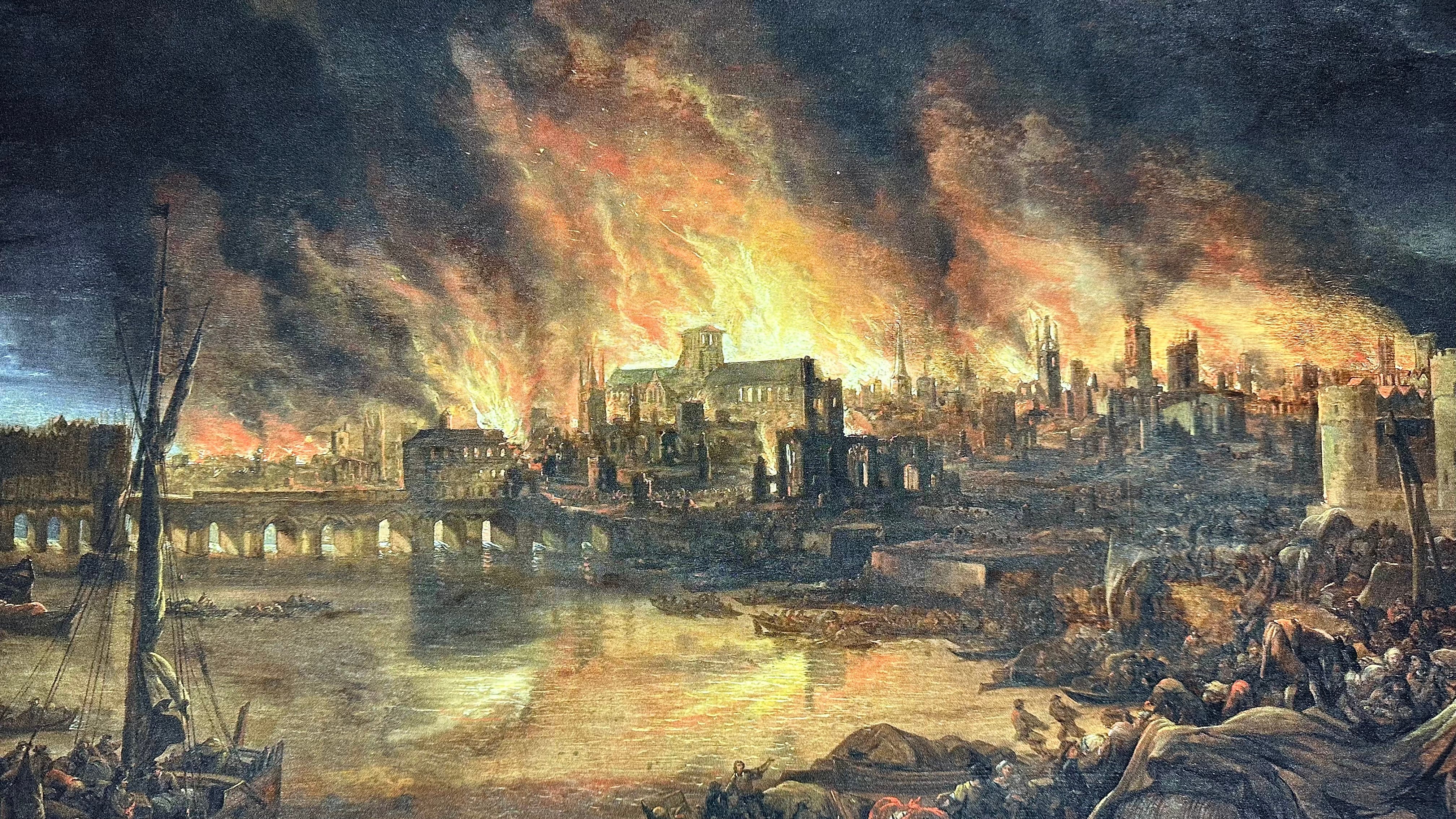
Last week I wrote about a man restoring a 1950s flashlight. Every original part back in. The same blue back on. Wren had a restoration in the works too. He never got to do it. What stands on that ground today is not Old St. Paul’s mended. It is a new building, on the same footprint, in a style the old one never had.
Two miles west stands another church. In a span of two days, I walked through them both.
An hour with my head down
The first was Westminster Abbey. I spent most of those hours looking at the floor.
Not praying. Reading. There are over 3,300 people buried or commemorated in that building, and a great many of them are underneath you.3 You’re not standing in a room that contains graves. You’re standing on them. Kings and poets and prime ministers. Newton and Darwin within a few steps of each other. And the names keep coming. After a while you notice your neck is tired and you haven’t once looked up.


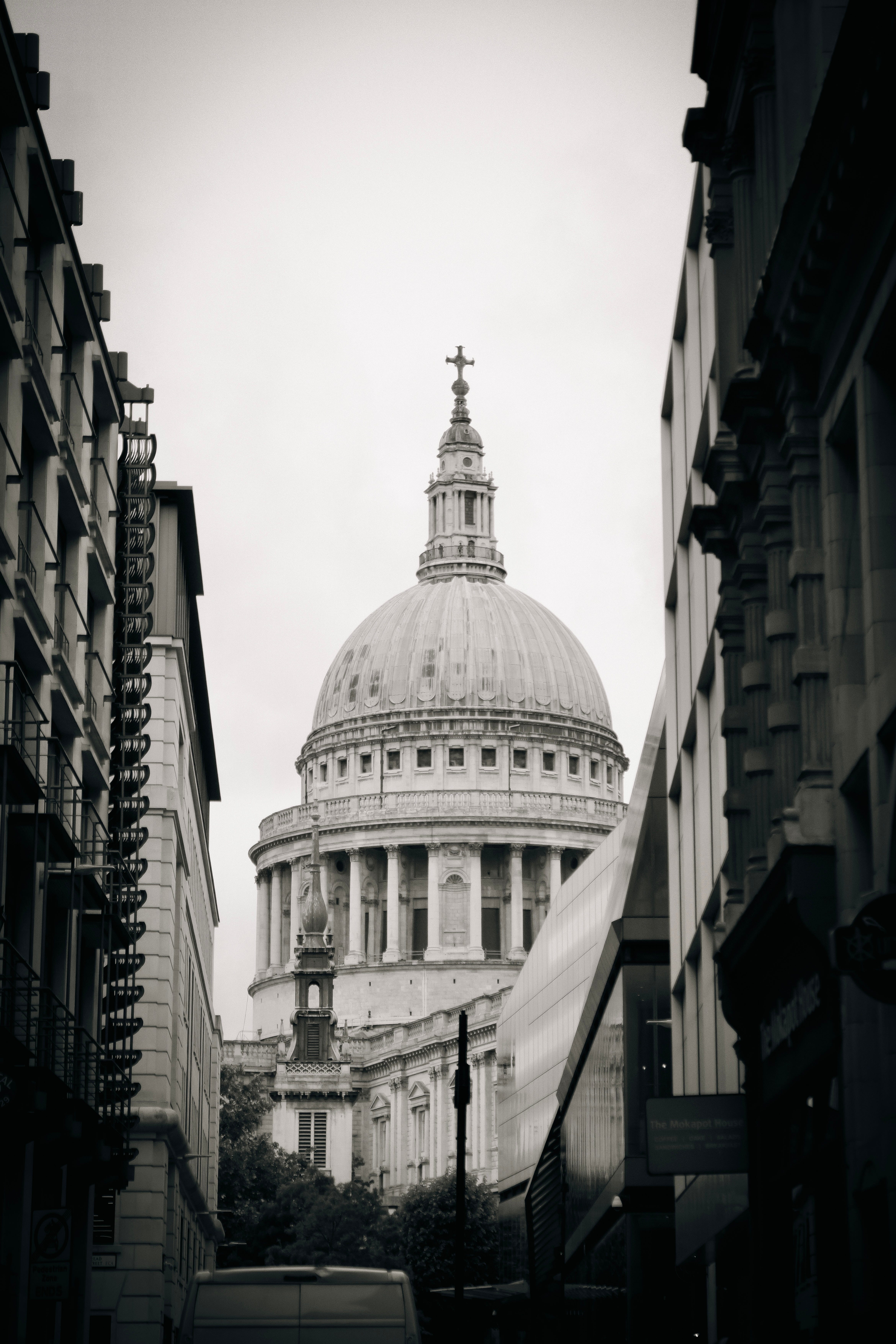
Two days later I walked into St. Paul’s and spent an hour with my neck bent the other way.
I want to be careful how I say this next bit, because I love the Abbey. I spend hours there every time I’m in London. That ceiling is one of the most beautiful things I have stood under, and if you make me choose, I’ll probably choose the Abbey. But the floor competes with the ceiling for attention, and the floor keeps winning. Crowded with the famous, thick with royalty and pomp. Some of them people of faith, some of them not. I came out feeling like I had toured a national attic more than a house of God.
The stone that points somewhere else
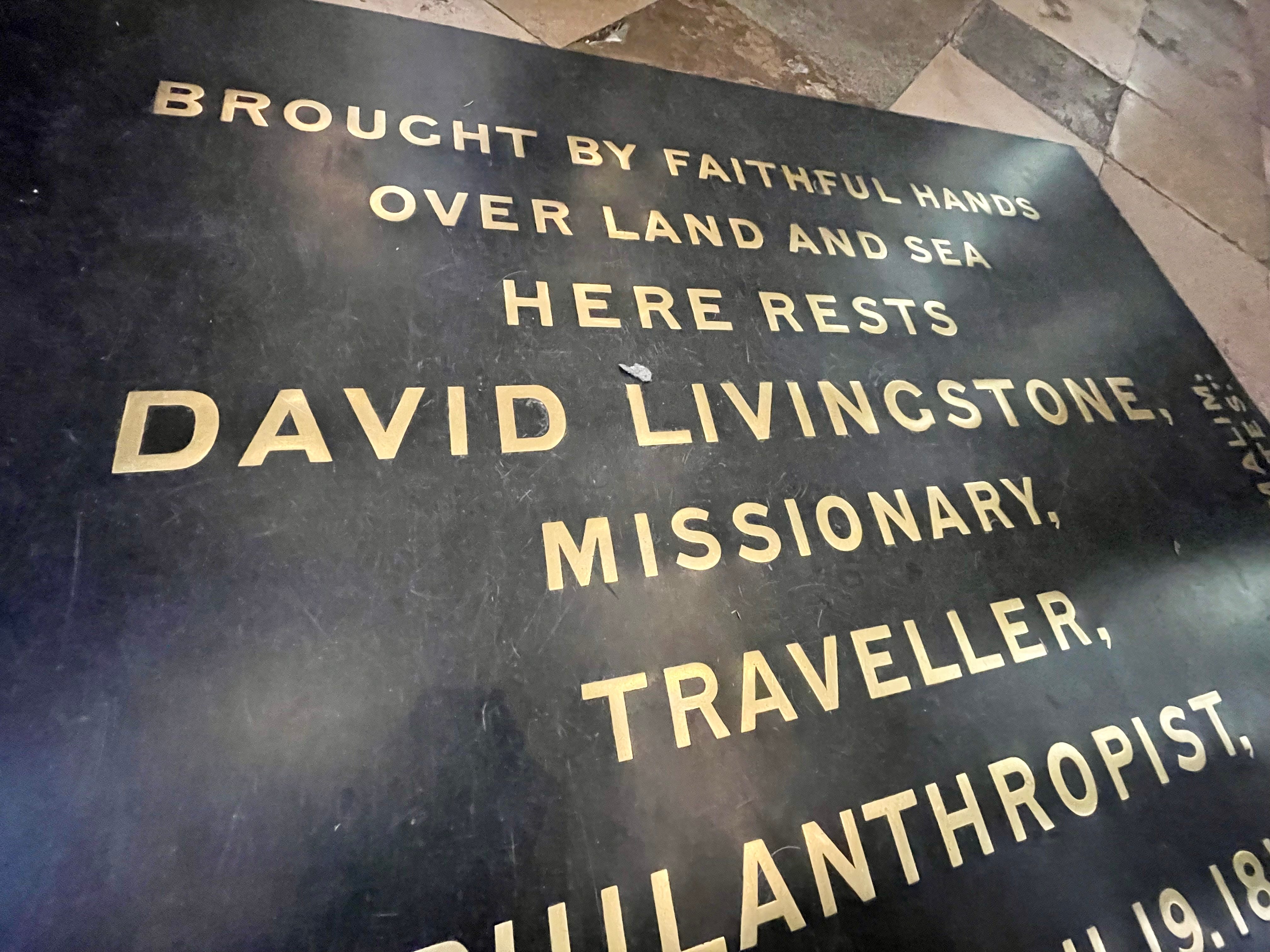
A slab in the middle of the Abbey’s nave carries a long inscription. It’s why I go. It begins:
BROUGHT BY FAITHFUL HANDS OVER LAND AND SEA HERE RESTS DAVID LIVINGSTONE, MISSIONARY, TRAVELLER, PHILANTHROPIST4
Livingstone died on the first of May, 1873, at a village in what is now Zambia. The account his companions give has him kneeling at his bedside.
Then his companions did something strange and careful, even though nobody asked them to. England didn’t know he was dead yet. Two of the men who had traveled with him for years, Chuma and Susi, decided on their own to send him home. No request from London. Nobody to report to. Nobody who would have known the difference if they had buried him where he fell. Before preparing the body and carrying it to the coast, they took out his heart and buried it there under an mpundu tree. Jacob Wainwright cut Livingstone’s name and a date into the bark.5
And on a plaque that’s been lost to history:
“Here lies the heart of David Livingstone. It was always in Africa, and now it will always remain here.”6
It took them nine months and a thousand miles before they reached Bagamoyo to set sail in February of 1874.7
And while his body lies in Westminster Abbey after a hero’s burial and the inscription Brought by faithful hands over land and sea, the part that matters most remains where it had always been.
My favorite stone in that floor points six thousand miles away from the building it’s sitting in.
You have to decide to descend
A cathedral is built to point toward a greater glory. That’s the job. The height, the light, the dome. Stone climbing well past the point where any of it is structurally necessary. All of it there to get your chin up and hand you a glimpse of something more vast than the room you’re standing in. A glimpse is all it can manage. And that’s enough. It’s pointing to a glory it cannot contain.
Walk into St. Paul’s, and nothing interferes with that. Not much is on the floor to look at. Everything is engineered to lift your eyes, and it does.


St. Paul’s does not refuse the descent. But it does relocate it.
To find the dead at St. Paul’s, you have to leave the worship space and go down a level on purpose. And when you enter the crypt, the man occupying the center, directly beneath that magnificent dome, is Nelson, with Wellington in a granite sarcophagus just beside him. The admiral and the general get the middle.
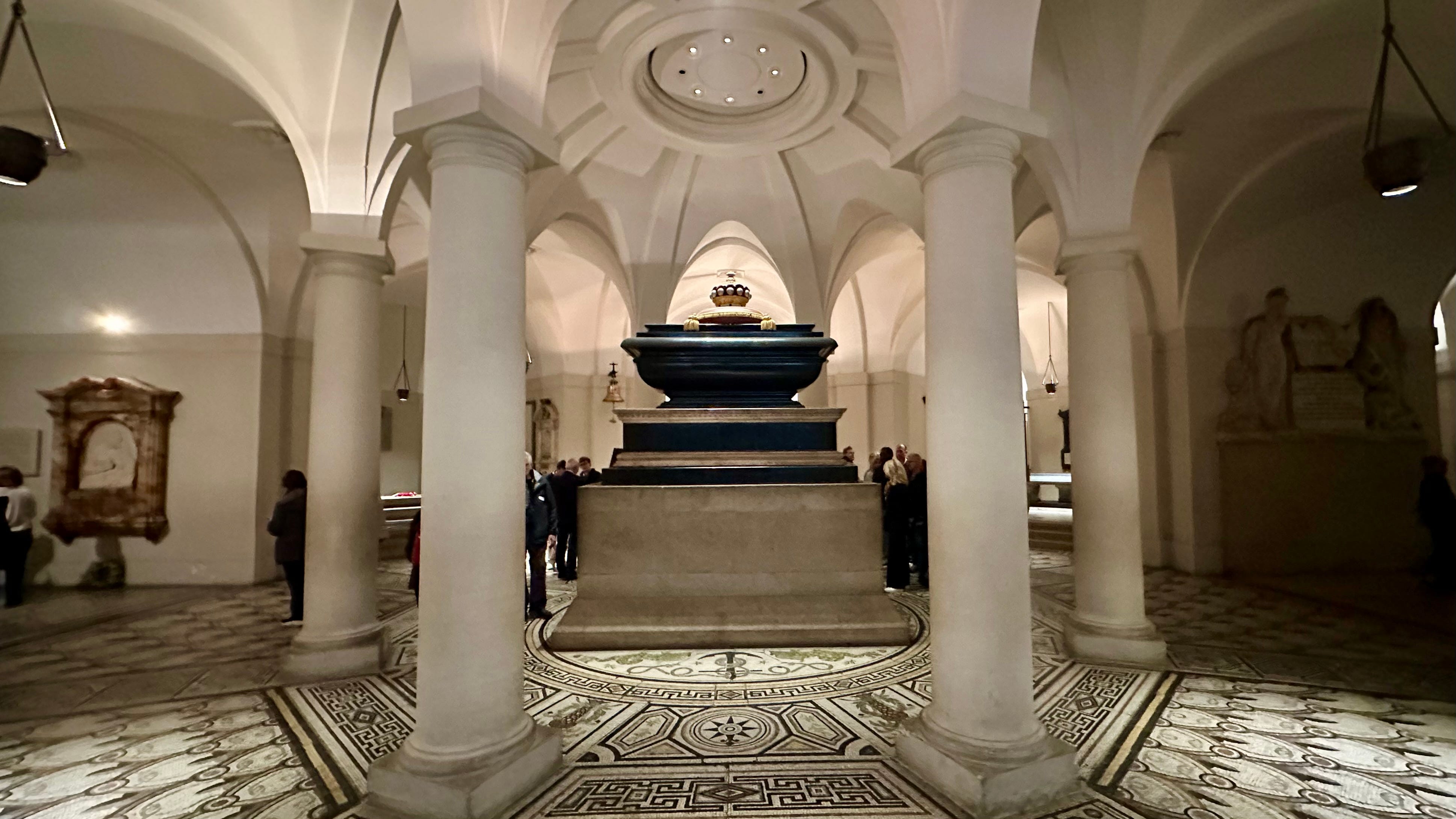
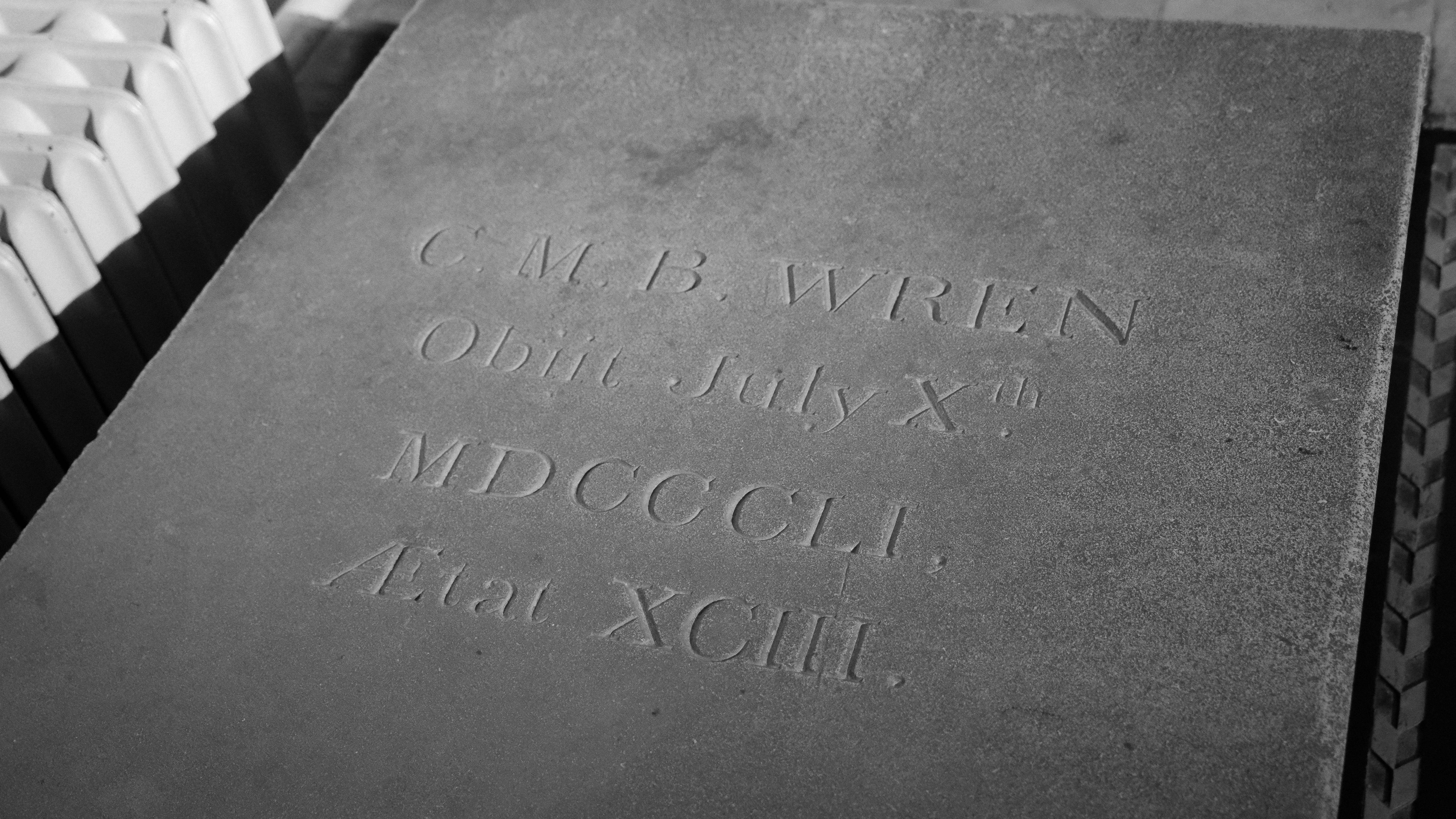
And Wren? The master architect. The man who gifted the whole thing to the world. He’s off in the southeast corner. No sculpture. No canopy. No ornament. Just a plain black slab, and above it a line his son wrote:
Here in its foundations lies the architect of this church and city, Christopher Wren, who lived beyond ninety years, not for his own profit but for the public good. Reader, if you seek his monument, look around you.8
The man who designed every inch of the ceiling over Nelson’s head declined the room’s best seat in the house. And the only thing he left was an instruction to stop looking at him.
That’s the difference. Both buildings are pointing at glory. At St. Paul’s nothing is competing with it. At the Abbey, three thousand famous people are.
The story about Wren I’m not going to tell
You may know the story. Wren is walking through the site during construction and asks three stonemasons what they are doing. The first says he’s cutting stone. The second says he’s earning a living. The third straightens up and says, I am building a cathedral to the Almighty.
It’s a wonderful story. I’ve told it from the stage more times than I can count, and I intend to keep telling it.
It also can’t be verified. It shows up in no biography of Wren, and the earliest anyone can trace it is a 1927 inspirational book that gives no source.9 I believe it anyway, and will go on telling it as though it did.
I think we like the story because we want it to be true. We want it to be true because we want our own ordinary work to mean something more than what it does from the outside. That longing isn’t silly. It’s close to the center of what it means to be a person who makes things that matter.
But here’s the part about Wren we do know for certain. He put not for his own profit but for the public good on his own grave, beneath the building, in a remote corner, where you have to go down two flights and search to find it. That is documented. It’s carved in stone. Literally.
It isn’t hard to picture a man who thought that way stopping on a job site to ask a mason what he thinks he’s doing. The story can’t be proved. But the posture can.
Count Zinzendorf spent his life sending Moravian missionaries to places most of them didn’t come back from, and the charge he is remembered for is three verbs long:
Preach the gospel, die, and be forgotten.10
That’s the same instruction Wren left on his slab. Different work, same charge.
In defense of looking down
Looking down is not the enemy. Scripture is full of downward looking, and the good kind. The tax collector in the temple would not so much as lift his eyes toward heaven, and he’s the one who went home justified.11 Jesus knelt on a floor with a towel and washed the feet of men who would abandon him within hours.12 He also stooped to write in the dirt while a crowd stood over a woman with rocks in their hands.13 Down is where mercy happens.
The crowd isn’t the problem either. If you want a minimalist heaven, you won’t find it in Revelation. John sees elders and angels and martyrs and a multitude from every nation that no one can number.14 Heaven is crowded. Wall to wall. If density were the disqualifier, the Abbey would be the more accurate building.
And the mix of saints and skeptics under the Abbey floor can be read generously. God has always worked through people who weren’t on the payroll. A poet who never darkened a church door still gave us something true. Burying him alongside kings and clergy was the Abbey conceding a point, whether it meant to or not. Theologians call it common grace: God hands out real gifts to people who never signed up for them.
So the crowd wasn’t what bothered me. When I finally got honest about it, it’s this:
Too many of us are striving to be remembered.
Not false glory. Fallen glory. And there’s a difference. False glory is a lie. Fallen glory is a real thing bent in the wrong direction, and fallen glory is precisely what the gospel deals with.


Remember me, look past me
Two buildings, two miles apart, two sentences.
The Abbey says remember me.
St. Paul’s says look past me.
I would love to tell you that the second sentence is mine and the other belongs to everybody else. It isn’t true. Both of them live in me, and I suspect both live in you too. I’ve wanted my name on things. I’ve wanted the work to be noticed as mine, and I’ve felt the small ugly drop in my stomach when it was noticed as someone else’s.
The Abbey is honest about what we want.
St. Paul’s is honest about what it is for.
A word for the one building something
You are building something right now. A career, a classroom, a marriage, a company, a ministry, a house, a name. A Substack following. You will leave something behind. That is not in question, and it was never optional.
The question is: what does it point to?
Jesus said it in one line, and it’s the plainest sentence in this whole essay:
Where your treasure is, there your heart will be also.15
We usually hear that as a warning about money, and it is. But read it as a map, and it tells you how to find something. Follow the treasure, and you’ll arrive at the heart. They are buried in the same ground.
Which is why Livingstone’s grave is the strangest and best thing about Westminster Abbey. His name is in London. His heart is in Zambia. The two are a continent apart, and there is no confusion at all about which one tells you what kind of man he was.16
I am not asking whether you’ll be remembered. I ask my students sometimes to tell me about their great-grandparents. Names, what they did for a living, what they were like. Most of them can’t do it. These are people whose blood is sitting in the chair, four generations down, and nothing can be said about them.
Which means you have roughly two generations of direct influence. Fifty years after you are gone, nobody is talking about you. That’s not cynicism; it is arithmetic. And the Abbey floor makes the same argument in stone. Three thousand three hundred names, and I could tell you maybe thirty of them.
I am asking a smaller and harder question. If somebody went looking for your monument, would they end up looking at you, or would they end up looking at what you were looking at?
The last stone
One last thing about Wren.
On the twenty-sixth of October, 1708, the highest stone of St. Paul’s was set at the very top of the dome. Wren was in his seventies and didn’t climb up to do it himself. His son, with the master mason, laid it in his stead.17
So the son set the last stone at the very top of the dome. Fifteen years later, that same son wrote the words that were cut into the slab over his father’s grave. The words that tell you to quit looking down at him and look up at what he built.
Reader, if you seek his monument, look around you.
John Evelyn’s diary for 27 August 1666 puts him in the room and on Wren’s side: “I was, with Dr. Wren, quite of another judgment… we totally rejected it, and persisted that it required a new foundation… we had a mind to build it with a noble cupola.” What the meeting agreed to was narrower than agreement with the dome. In Evelyn’s words, “we offered to bring in a plan and estimate, which after much contest, was at last assented to.” Six days later it was moot. Worth noticing that the dome was in the drawing before the fire, not after. He had already imagined the thing that would become his monument, and the fire cleared the site.
The fire began in Thomas Farriner’s bakery in Pudding Lane in the small hours of Sunday, 2 September 1666, and reached the cathedral on the fourth. Contemporary accounts describe molten lead from the roof running in the streets. Wren was appointed architect of the new cathedral on 13 November 1673, held the first service in the Quire in 1697, and lived to see Parliament declare the building complete on Christmas Day, 1711.
The Abbey’s own figure. The one grave nobody is allowed to walk on is the Unknown Warrior, buried 11 November 1920. The only untreadable stone in that building belongs to a man whose name nobody knows, which is a sermon all by itself.
The inscription continues with his birth at Blantyre, Lanarkshire, on 19 March 1813 and his death on 1 May 1873. It also misspells the place of his death, cutting “Ilala” to “Ulala.” The most-visited floor stone in the Abbey has a typo, which I find oddly comforting.
Wainwright cut “LIVINGSTONE MAY 4 1873” into the bark along with the names of the attendants. A section of that tree was later cut out and is now in a museum collection in London, which means the marker and the heart also ended up on separate continents.
That is the version I have told for years, and I cannot source the wording. I heard it thirty years ago, and keep it because it’s too beautiful to give up. The tree is gone now; the section bearing Wainwright’s carving was cut out in 1899 and shipped to the Royal Geographical Society in London, and a brick monument stands on the spot instead. Whether or not anyone ever cut those exact words into a plaque, they are an accurate account of the man, and I am going to keep saying them.
Horace Waller, ed., The Last Journals of David Livingstone in Central Africa, vol. 2 (John Murray, 1874), which preserves Chuma and Susi’s own account, is the source for all of this: the incision, the fourteen days’ drying, the bark case, the sailcloth sewn over the body, journey out.
Subtus conditur huius ecclesiæ et vrbis conditor Christophorus Wren, qui vixit annos ultra nonaginta, non sibi sed bono publico. Lector si monumentum requiris circumspice. Written by Christopher Wren the Younger. The Latin for “not for himself but for the public good” is doing quiet work: it is a claim about motive, made by a son, about a father, in a place where nobody would see it unless they went looking.
The earliest appearance anyone has traced is Bruce Barton, What Can a Man Believe? (Bobbs-Merrill, 1927), 252.
Nikolaus Ludwig von Zinzendorf (1700–1760), who led the Moravian community at Herrnhut and sent its missionaries out to the Caribbean, Greenland, and the American colonies.
Luke 18:13–14. “He would not even look up to heaven, but beat his breast.” Luke tells us plainly, one verse later, which of the two men in that story went home right with God, and it is not the one with the good posture.
John 8:6. John never tells us what he wrote, which has not stopped anybody from guessing for two thousand years. The posture is the part I want: everyone else on their feet with stones in their hands, and him down on the ground. And notice whose finger it is. Exodus 31:18 says the law was written on stone tablets by the finger of God. The finger that cut the law into stone is the same finger that writes in dirt, and what it writes there lets her walk away from the penalty that law required.
Revelation 7:9–14: the multitude in verse 9, the angels and elders in verse 11, the ones who came out of the great tribulation in verse 14. Also, Hebrews 12:1, the great cloud of witnesses, which is as close as Scripture comes to describing the Abbey floor on purpose.
Matthew 6:21, the end of a paragraph that begins at verse 19 with moths and rust and thieves. Note the order in the sentence. The treasure goes first, and the heart follows it. Jesus is not telling us to relocate our affections by willpower. He is telling us that our affections will end up wherever we have already been putting our investment, which is a more uncomfortable claim and a more useful one.
Livingstone was a complicated man, and I don’t want to hand you a plaster saint. He was a poor husband and a worse manager; his geography was sometimes off, and the century he belonged to did terrible things in Africa partly in the wake of men like him. But he was also relentless against the slave trade, and the men who knew him best carried his body a thousand miles when they had every reason not to. Both things are true at the same time. Psalm 115:1 applies to him as much as to anyone: not to us, Lord, not to us.
The cathedral was topped out on 26 October 1708 when the final stone was laid on the lantern. Wren was in his seventies by then, and the ceremony was performed by his son Christopher together with Edward Strong, the master mason. Parliament declared the building officially complete on Christmas Day, 1711.